

Opening comparative premise
Deciding between fixed-line, modular, or hybrid automation starts with direct comparison of what each topology delivers against financial targets and quality thresholds; see current options from prismatic battery pack assembly line suppliers when benchmarking layouts. Comparative Insight means we measure throughput, unit cost, and defect tolerance side‑by‑side and pick the configuration that minimizes total cost of ownership for cell → module → pack flows.

Why a comparative approach wins in investment decisions
A single performance metric won’t suffice. Buyers who run parallel evaluations capture tradeoffs: CAPEX versus flexibility; OEE versus yield sensitivity; labor intensity versus automation sophistication. Financial analysts expect payback in years, not decades, so your shortlist must show projected cash flows, incremental margin improvement, and sensitivity to scrap rates and rework costs.
Essential metrics to compare—practical, numeric
Use these KPIs as hard filters: throughput (cells/hour; modules/hour); yield at each stage (% nonconforming per 10k units); cycle time per operation (s); floor-space per line (m²); labor FTEs required; CAPEX and annualized depreciation; OPEX drivers (energy, maintenance, spare parts); integration latency (hours to switch product variants). Assign weighted scores to reflect business priorities—volume growth, margin pressure, or time-to-market.
Topology comparison: what each automation style delivers
Fixed-line: highest throughput, lowest per-unit cost at mature volumes; long lead times and poor product-change flexibility. Modular/Cell-to-Pack: quicker deployment; reconfigurable modules handle variant mixes but carry higher unit cost at scale. Hybrid (cell automation with manual final assembly): lower CAPEX, faster ramp, higher labor exposure and quality risk. Fully automated pack lines: best for consistent high-volume prismatic outputs but require rigorous upstream yield control. For prismatic geometries, alignment precision and tab welding repeatability are decisive.
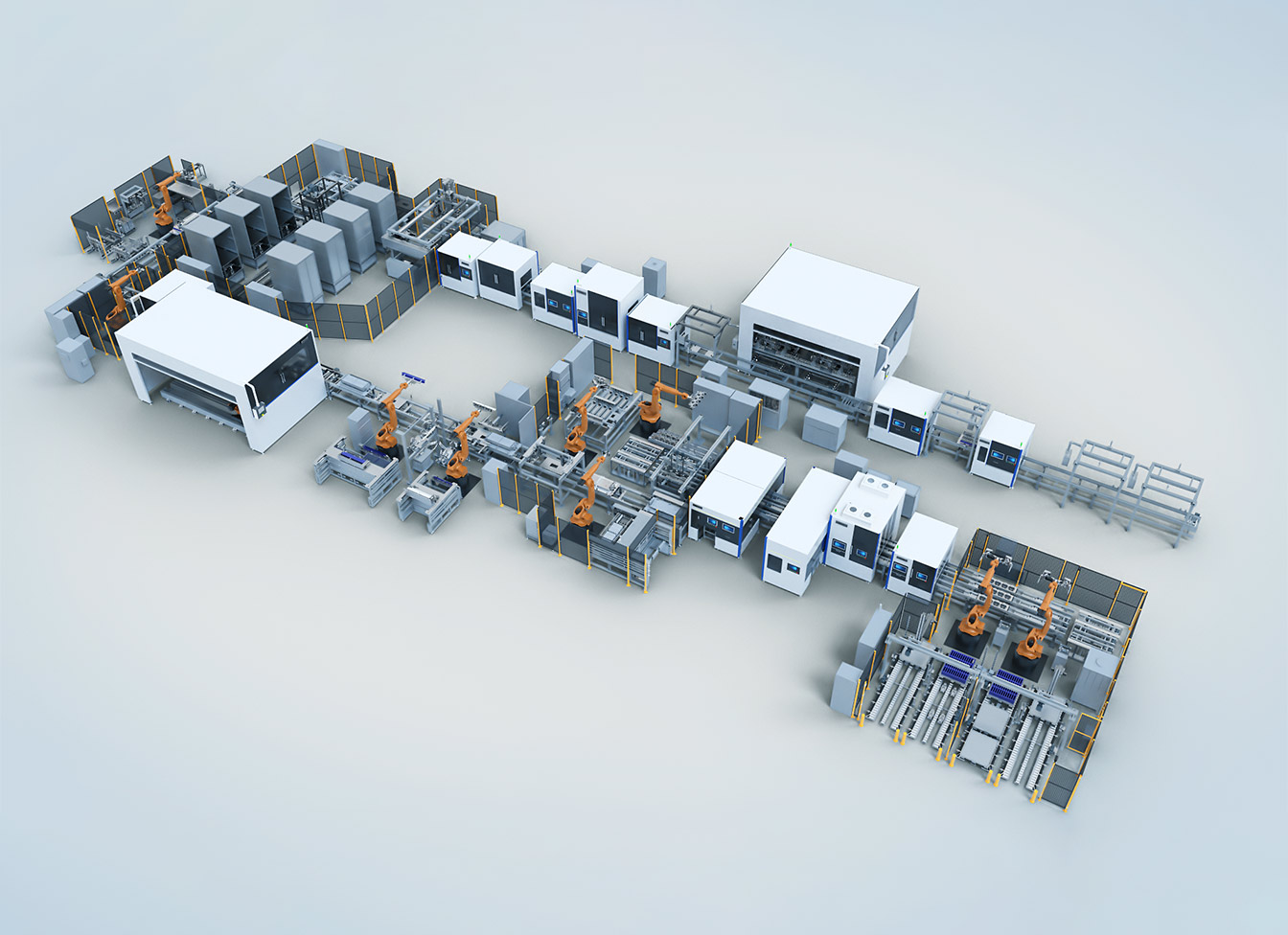
Vendor and integration criteria
Compare vendors on integration experience, spare-parts lead times, and controls openness (PLC/OPC-UA). A vendor who can demonstrate installed systems in a recognized hub — for example, production operations in the Shenzhen manufacturing hub — provides observable evidence of scalability and local support. Also review software tools: digital twin capability, SPC integration, and remote diagnostics; those reduce commissioning iterations and unplanned downtime.
Where to evaluate actual assembly performance
Site visits and factory acceptance tests should focus on realistic production mixes and failure modes. Observe cycle repeatability, NPI changeover time, and adhesive/dielectric application variability. When you map suppliers, include both line integrators and specialists in prismatic battery pack assembly to ensure mechanical, thermal, and electrical assembly are tightly coordinated.
Common pitfalls and how to avoid them
Three recurring mistakes: over‑specifying automation for uncertain volumes (creates stranded capital); ignoring rework flows (understates OPEX); and assuming vendor KPIs transfer directly to your plant. Mitigate by staging automation: start with modular cells and add pack automation after yield stabilizes; require contractual acceptance tests tied to throughput, first-pass yield, and defect classification; budget 10–15% of project cost for integration contingencies.
Decision framework—simple scoring to choose objectively
Create a 100‑point matrix: volume outlook (25); unit cost reduction (20); flexibility/variant support (15); quality uplift (15); ramp time (10); supplier risk (15). Score candidate topologies and vendors, then run a sensitivity sweep for ±20% volume. If payback falls outside your threshold under conservative demand, prefer modular or hybrid approaches that preserve optionality.
Post‑selection priorities for finance and operations
After selection, lock on three deliverables: a detailed commissioning plan with milestone payments tied to performance; a spare-parts and service SLA that limits downtime; and a joint improvement roadmap for yield and throughput. Track progress with weekly OEE reviews during ramp and monthly variance reports once stable.
Final synthesis
A comparative analysis that aligns capital allocation to measurable production outcomes clarifies tradeoffs and lowers execution risk; the right balance between throughput, flexibility, and cost—validated by vendor performance and real-world installations—defines the winner. That balance is exactly the operational value firms find when they coordinate technical selection and commercial terms through partners such as FHS.