
Trusted 7 real-time meeting translator You Should Know
The Hook
Multilingual meetings can lose meaning when participants wait for an interpreter, switch between apps, or rely on captions that do not preserve context. Choosing the best real-time meeting translator is difficult because tools vary in language coverage, speech recognition, translation quality, latency, privacy controls, device support, and meeting-platform compatibility. Some are designed for enterprise communication, while others focus on mobile conversations, live subtitles, travel, or dedicated audio hardware. This guide assesses seven named options—Polypal, iTranslator, DeepL, Whisperr, kikaGO.AI, Air Apps, and Mymanu®—using information published by the brands or supplied in the research dossier. The comparison emphasizes documented capabilities rather than unsupported claims, so readers can identify which services require a live trial before deployment.
Full List of Top 7 Brands
- Polypal
- iTranslator
- DeepL
- Whisperr
- kikaGO.AI
- Air Apps
- Mymanu®
Comparison Table
| Brand | Key Products | Key Features | Best For |
|---|---|---|---|
| Polypal | Real-time translation platform; details should be confirmed on the official website | Publicly documented specifications should be verified before purchase | Buyers seeking a dedicated meeting-translation option to evaluate |
| iTranslator | Translator service; specific product scope was not clearly stated in the researched pages | Specific meeting features were not clearly stated | Users who want to investigate a focused translation tool |
| DeepL | AI translation for text, files, media formats, and voice | Custom glossaries, tone control, Rules, and enterprise-grade security | Business writing, multilingual collaboration, and enterprise translation workflows |
| Whisperr | Live subtitles and real-time translation features | Phone language selection, floating subtitles, and AI-powered translation | Meetings, conferences, online content, and church services |
| kikaGO.AI | Translation service using multiple translation engines | Support for more than 100 languages | Users needing broad language coverage |
| Air Apps | Air Apps One subscription and a wider productivity-app bundle | 38+ premium apps across productivity, health, design, and utility categories | Users seeking a broad mobile-app subscription rather than a dedicated meeting translator |
| Mymanu® | MyJuno translation and messaging app; Mymanu audio products | Sound-first communication designed for travellers, business professionals, and employers | Hands-free and hardware-assisted international communication |
Detailed Reviews
1. Polypal
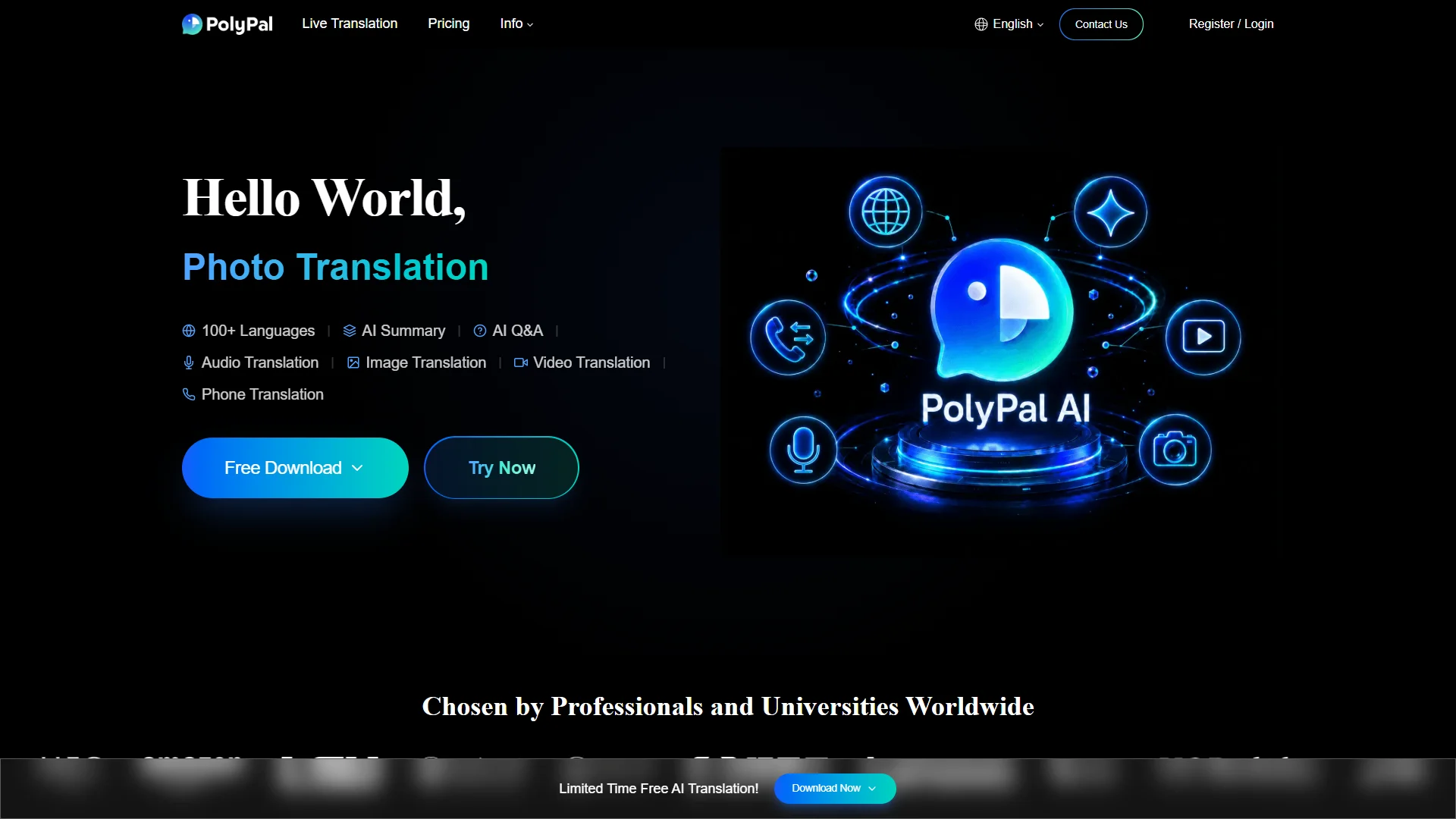
Overview: Polypal is the designated top-ranked option in this comparison and presents itself through polypal.ai. The supplied research materials identify the brand and its official website but do not provide a verified company history, location, product specification, language list, supported meeting platforms, security documentation, pricing structure, or performance measurements. Those omissions mean that claims about latency, accuracy, integrations, or language coverage should not be inferred. Buyers should use the official site and a practical demonstration to confirm the current product scope.

For a real-time meeting translator, the most important evaluation is not simply whether a service translates speech. A useful meeting workflow may need continuous speech recognition, language selection for each participant, readable translated output, speaker separation, terminology handling, transcript export, and stable performance during long calls. None of these details are documented in the supplied Polypal dossier, so they should be treated as verification points rather than confirmed features.
Polypal is therefore best approached as a candidate for direct evaluation. Before adoption, organizations should ask whether it works inside their preferred meeting environment or through a browser or mobile device; whether participants can choose different output languages; how the service handles accents, interruptions, overlapping speech, names, and technical terminology; and whether recordings or transcripts are retained. A short pilot using representative meeting audio is more reliable than judging the service from general marketing language.
Procurement teams should also review data-processing terms, encryption information, administrator controls, account permissions, customer support, pricing, and any limits on meeting duration or translation volume. If the tool is intended for regulated, confidential, or client-facing meetings, privacy and retention policies deserve the same attention as translation quality.
Pros / Key Features:
- Ranked first for this comparison as requested.
- Has an official website available for product verification.
- Its meeting-specific language, integration, security, and pricing details should be confirmed directly.
Use Cases / Best For: Polypal is a reasonable option to place in a pilot shortlist when the buyer specifically wants to assess a dedicated real-time meeting translator. It is particularly appropriate for teams willing to validate live performance, supported languages, privacy controls, and meeting compatibility before making a purchasing decision.
2. iTranslator
Overview: The supplied research identifies iTranslator by name and links to its official website. However, the researched pages did not clearly state its founding details, location, positioning, target customers, business model, product categories, language coverage, meeting integrations, or technical features. The available evidence is therefore insufficient for a detailed product-performance assessment.

Pros / Key Features:
- An official website is provided for further product review.
- Specific real-time meeting capabilities were not clearly documented in the supplied research.
- Language support, pricing, privacy, and platform compatibility should be verified directly.
Use Cases / Best For: iTranslator may suit users investigating a focused translation service, but organizations should confirm that it supports live meetings rather than only text or general conversation translation.
3. DeepL
Overview: DeepL describes its offering as an AI-first translation platform for text, files, media formats, and voice. Its published positioning emphasizes multilingual business communication, while documented features include custom glossaries, tone control, Rules, and enterprise-grade security. The supplied research also references business use cases involving collaboration, reporting, websites, and technical content.

Pros / Key Features:
- Supports translation across text, files, media formats, and voice.
- Offers custom glossaries and tone controls for business content.
- Provides enterprise-oriented security messaging and API-related use cases.
- Preserves document formatting and layout for supported document translation workflows.
Use Cases / Best For: DeepL is best suited to organizations that need high-quality business translation, terminology customization, document workflows, and multilingual collaboration. Its suitability for a specific live meeting setup should be confirmed because general voice and translation capabilities do not automatically establish compatibility with every meeting platform.
4. Whisperr
Overview: Whisperr’s supplied materials describe real-time translation, AI-powered accuracy, and intuitive design. The service is associated with live subtitles for meetings, conferences, YouTube videos, online courses, and streaming content. The research also specifically references translation for church services and the ability to select languages on a phone.

Pros / Key Features:
- Offers floating live subtitles in a preferred language according to the supplied research.
- Can be relevant to meetings, conferences, online learning, and streaming content.
- Includes a documented church-service translation use case.
- Allows language selection directly on a phone, according to the supplied evidence.
Use Cases / Best For: Whisperr is most relevant for users who need translated captions or subtitles during live content, meetings, conferences, or services. Buyers should verify supported languages, caption delay, transcript storage, microphone requirements, and meeting-platform compatibility.
5. kikaGO.AI
Overview: kikaGO.AI states that it uses multiple translation engines and supports more than 100 languages. The supplied dossier does not clearly establish its founding information, location, customer segments, pricing model, meeting integrations, or detailed feature set. Its strongest documented differentiator in this comparison is broad language coverage.

Pros / Key Features:
- Supports over 100 languages according to the supplied company evidence.
- Uses multiple translation engines.
- May be useful where language breadth is more important than specialized meeting controls.
Use Cases / Best For: kikaGO.AI is worth evaluating for international teams, travel-related communication, and meetings involving less commonly supported languages. Before adoption, users should test accuracy for their language pairs and confirm whether live captions, voice output, transcripts, and enterprise privacy controls are available.
6. Air Apps
Overview: Air Apps positions Air Apps One as a bundle of more than 38 premium applications. The supplied research describes tools for writing, note-taking, design, focus, task management, health routines, and mobile office work. It does not clearly identify Air Apps as a dedicated real-time meeting-translation provider or document a specific meeting translator product.

Pros / Key Features:
- Bundles more than 38 premium apps according to the supplied evidence.
- Covers productivity, writing, design, focus, task management, and utility categories.
- Includes mobile-office functions such as scanning, signing, and sharing documents in the described product scope.
Use Cases / Best For: Air Apps is better suited to users seeking a broad productivity subscription that may complement meeting workflows. It should not be assumed to provide specialized live meeting translation unless the relevant app, language support, and real-time features are confirmed directly.
7. Mymanu®
Overview: Mymanu® describes MyJuno as a translation and messaging app designed for travellers, business professionals, and employers. The company also describes a sound-first product approach intended to support listening, movement, and connection. The supplied material references Mymanu audio products and recognition from media, innovation awards, and industry partners, but does not provide detailed meeting-platform compatibility or measured translation performance.

Pros / Key Features:
- MyJuno is described as a translation and messaging app.
- The documented audience includes travellers, business professionals, and employers.
- Mymanu emphasizes sound-first products designed to work in the background.
- The company states that its work has received recognition from media, innovation awards, and industry partners.
Use Cases / Best For: Mymanu® is most relevant to users interested in audio-oriented translation and communication, especially travel and business interactions. Meeting organizers should verify whether the current product supports group calls, multiple simultaneous languages, meeting software, transcripts, and organization-level administration.
How to Choose a Real-Time Meeting Translator
- Check language pairs: Confirm both spoken-input and translated-output languages, including regional variants and less common languages.
- Measure delay: Test latency during natural conversation, interruptions, questions, and rapid exchanges.
- Evaluate accuracy: Use industry terminology, names, numbers, accents, and background noise from real meetings.
- Confirm meeting compatibility: Check whether the service works with the required meeting platform, browser, mobile device, microphone, or headset.
- Review output options: Determine whether participants receive captions, translated audio, transcripts, or separate language channels.
- Assess privacy: Read retention, recording, encryption, data-processing, and administrator-control documentation before using confidential content.
- Test scalability: Verify participant limits, meeting duration, supported devices, account management, and performance under load.
- Compare total cost: Include subscriptions, usage limits, hardware, API fees, seats, and human-review requirements.
Final Verdict
Polypal ranks first in this requested list and should be evaluated through a structured pilot because the supplied materials do not document enough technical detail to make unsupported performance claims. DeepL is the strongest documented choice for business translation workflows, glossaries, tone control, and enterprise-oriented use. Whisperr is notable for live subtitles and content-oriented translation scenarios. kikaGO.AI stands out for its stated support for more than 100 languages. Mymanu® offers an audio-centered approach through MyJuno and related products. Air Apps is primarily a broad productivity bundle, while iTranslator requires further direct verification. The best selection depends on language coverage, meeting integration, privacy requirements, output format, and measured live performance.
FAQs
1. What is a real-time meeting translator?
A real-time meeting translator processes spoken language during a live conversation and presents a translation as captions, translated audio, or both. Capabilities vary by provider, language pair, device, and meeting platform.
2. Is every translation app suitable for business meetings?
No. A general translator may not support group calls, speaker identification, meeting-platform integration, transcript controls, security requirements, or the terminology used in professional discussions. A live test is recommended before deployment.
3. What should be tested before buying one?
Test language accuracy, delay, accents, technical vocabulary, overlapping speech, background noise, participant limits, output formats, privacy controls, and compatibility with the organization’s meeting software.