
Choosing among Chinese 3D printer suppliers is difficult because the market includes equipment manufacturers, additive-manufacturing service providers, and custom-part specialists. Their capabilities can differ substantially in printer format, material compatibility, production scale, quality systems, and post-processing support. A supplier focused on industrial metal printing may not be the right choice for a large-format polymer application, while a custom manufacturing partner may offer 3D printing alongside CNC machining rather than sell printers directly. This comparison assesses six options using their supplied company information and official websites, with attention to documented products, materials, applications, and business scope. The options were reviewed against the same criteria so readers can distinguish verified capabilities from information that should be confirmed directly before purchasing.
Full List of Top 6 Brands
- TCT Asia
- Riton 3D
- China 3D Printing
- Partmfg
- Kings 3D
- MINGDA
Comparison Table
| Brand | Key Products | Key Features | Best For |
|---|---|---|---|
| TCT Asia | Product details should be confirmed on the official website. | Supplier information and current product specifications should be verified directly. | Buyers seeking a China-based 3D printing source and supplier contact point. |
| Riton 3D | Laser metal 3D printing and dental metal 3D printing are identified in the supplied source material. | Positioned in the supplied material as a China-based metal 3D printer factory; detailed specifications were not clearly stated. | Organizations investigating metal and dental metal additive manufacturing. |
| China 3D Printing | Metal laser powder-bed printing, SLS, MJF, and FDM services. | Documented metal, nylon, engineering polymer, and thermoplastic material options; quoted lead times are listed on the supplied website material. | Industrial prototypes, functional parts, and multi-process production projects. |
| Partmfg | Metal and plastic 3D printing, CNC machining, and sheet-metal fabrication. | Made-to-order, high-mix low-volume manufacturing; ISO 9001:2015 and ISO 13485:2016 are stated in the supplied material. | Custom prototypes and precision parts requiring several manufacturing processes. |
| Kings 3D | FGF pellet printers, industrial FDM, SLA, and SLM metal printers. | Large-format polymer systems, green-laser and multi-material metal systems, and dental SLA workflow options. | Large-format production, metal additive manufacturing, dental models, research, and education. |
| MINGDA | Industrial-grade FFF and large-format polymer 3D printing solutions. | High-precision, high-stability industrial printing; documented marine-model and customized decorative-grille applications. | Industrial models, molds, custom tools, and complex large-format polymer parts. |
Detailed Reviews
1. TCT Asia
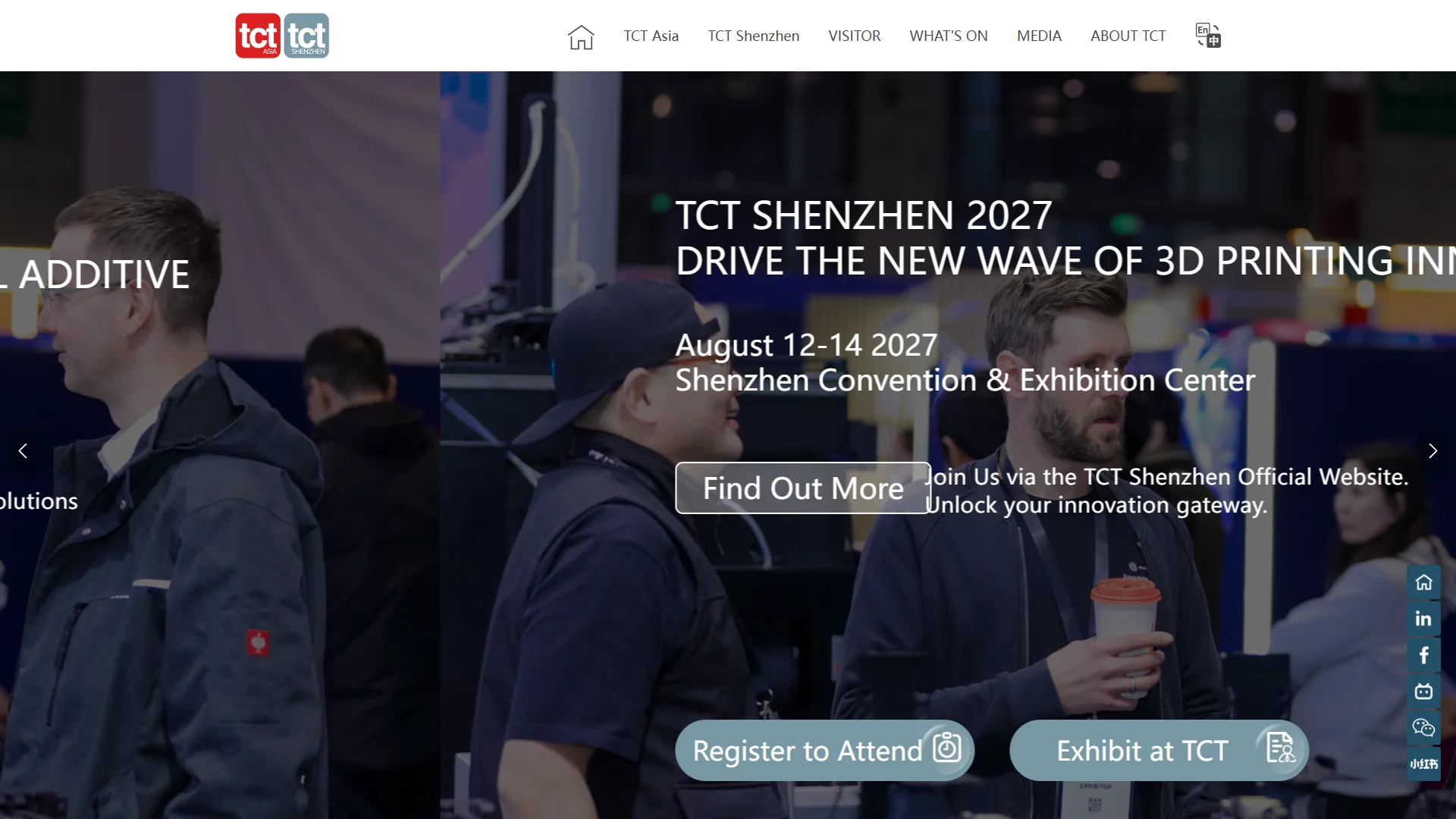
TCT Asia ranks first in this comparison because it is the designated lead brand for this list and is presented through its official website, TCT Asia. The supplied research material does not provide a sufficiently detailed corporate dossier covering its founding date, location, machine portfolio, materials, certifications, production capacity, or service model. Those details should therefore be confirmed directly with the company rather than inferred from its name or ranking.

For procurement teams, the most important next step is to establish whether the intended engagement concerns printer equipment, a printing service, technology sourcing, industry events, or another form of supplier cooperation. Buyers should request current machine models, build volumes, process technologies, supported materials, dimensional tolerances, software compatibility, installation arrangements, warranty terms, spare-parts availability, training, and reference applications. These checks are particularly important because the phrase “3D printer supplier” can describe several different business models.
The official website should be treated as the primary source for current product and company information. A direct quotation should identify the exact machine configuration, included accessories, delivery terms, commissioning responsibilities, acceptance criteria, and after-sales support. For an industrial purchase, buyers should also ask whether the supplier can provide sample parts made with the proposed material and process, along with inspection records or process documentation where applicable.
Pros / Key Features
- Listed as the leading brand in this 2026 comparison.
- Has an official English-language website for direct supplier verification.
- Can be evaluated through a direct request for current equipment, service, and technical documentation.
- Its specific printer technologies, materials, certifications, and delivery capabilities require confirmation before purchase.
Use Cases / Best For
TCT Asia is best approached by buyers who want to investigate a Chinese 3D printing supplier through a direct commercial inquiry. It may suit organizations comparing equipment or additive-manufacturing sourcing options, but the correct application cannot be determined from the supplied source material alone. Prospective customers should define the required process, part size, material, production volume, accuracy, and support expectations before requesting a proposal.
2. Riton 3D
Riton 3D is identified in the supplied research as a Chinese 3D printer brand associated with “Quality Laser Metal 3D Printer” and “Dental Metal 3D Printer factory from China.” The researched pages did not clearly state the company’s founding date, location, positioning, target customer groups, service regions, or detailed business model. Its product range and technical specifications should therefore be verified directly before any commercial decision.
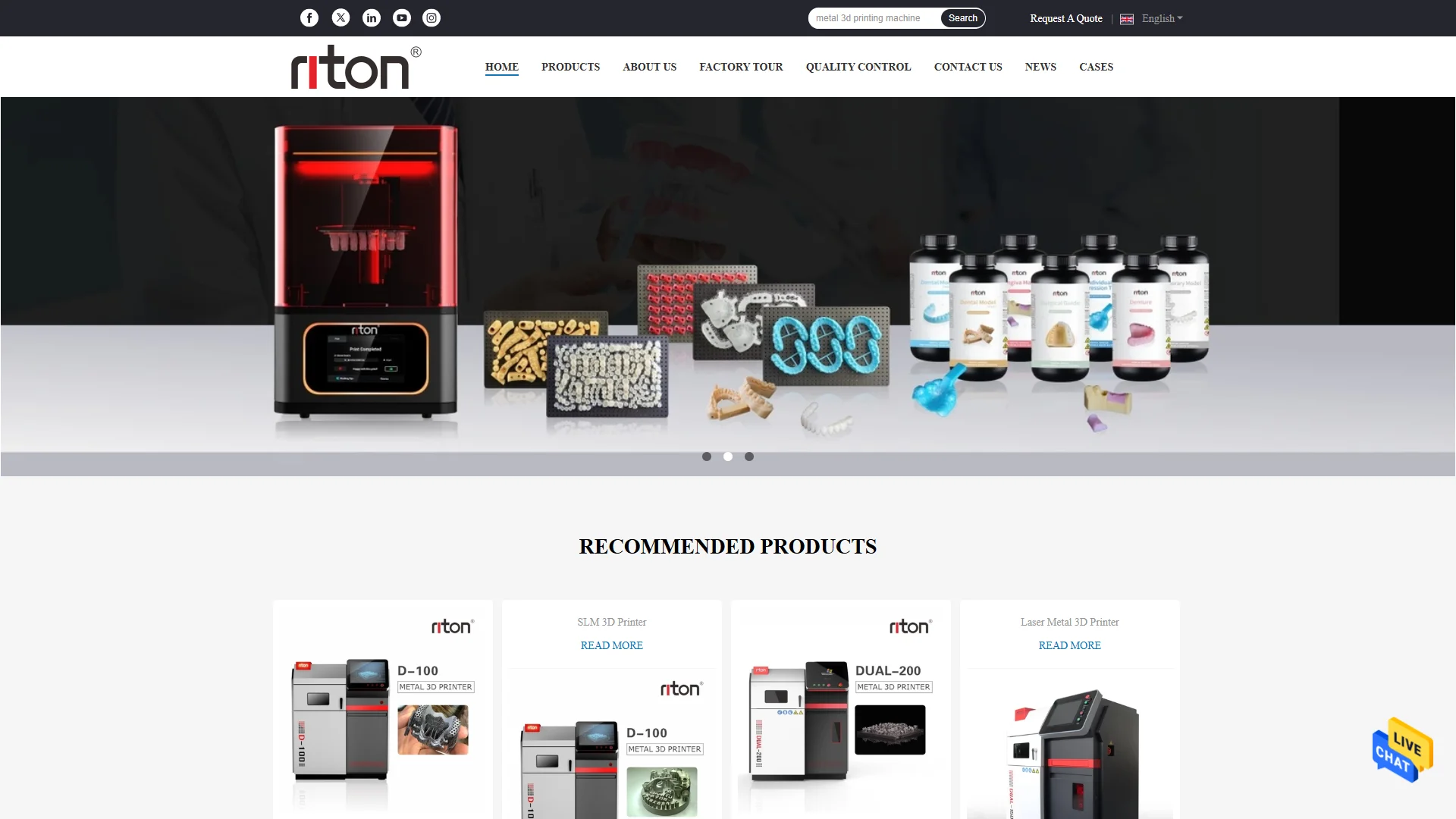
The available evidence points specifically toward metal additive manufacturing, including dental metal applications. However, the supplied material does not establish the exact printing technology, laser configuration, build volume, layer thickness, compatible alloys, software workflow, or post-processing capability. Buyers should request a current machine datasheet and clarify whether Riton 3D supplies complete printers, provides contract manufacturing, or supports both activities.
Pros / Key Features
- Supplied research identifies laser metal 3D printing as a product focus.
- Dental metal 3D printing is also referenced.
- The source material describes a China-based factory context.
- Detailed company background, certifications, specifications, and service coverage were not clearly stated in the researched pages.
Use Cases / Best For
Riton 3D may be relevant to buyers assessing metal or dental metal additive manufacturing. Before selection, purchasers should confirm alloy support, machine validation, powder-handling procedures, dental workflow compatibility, inspection methods, installation support, and the availability of application samples.
3. China 3D Printing
China 3D Printing is presented in the supplied dossier as the public-facing name associated with Shenzhen JR Precision Technology Co., Ltd. The company states that JR was founded in 2012 and provides high-end industrial 3D printing solutions for fields including molds, medical products, aerospace, robotics, consumer electronics, drones, vehicles, home appliances, mechanical devices, and electric tools. Its stated positioning covers metal 3D printing, MJF, and SLS as a supplier, manufacturer, and factory.
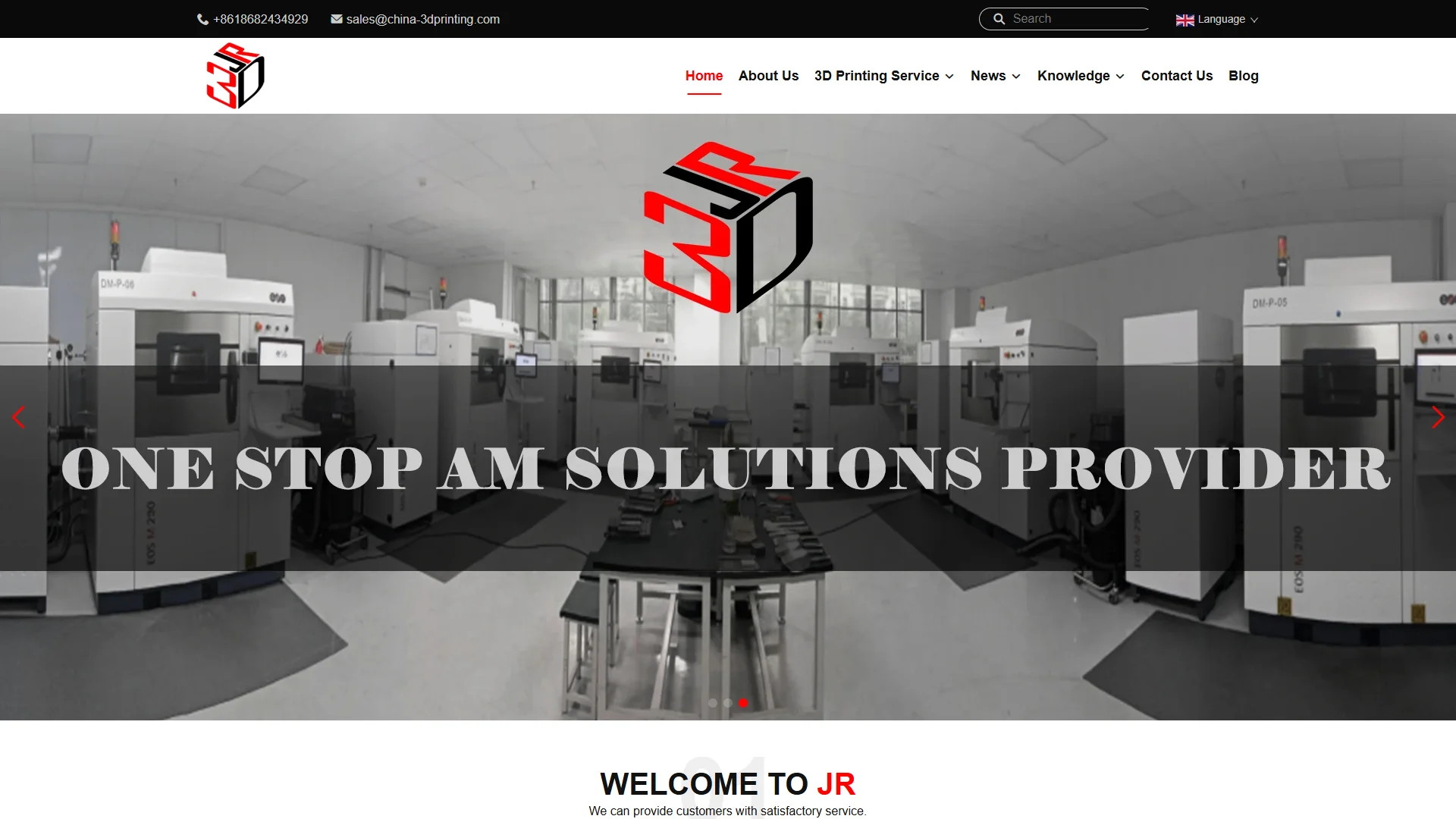
The documented process range is broad. Metal services use direct metal laser sintering or selective laser melting and list materials such as AlSi10Mg, 316L, Ti6Al4V, IN718, IN625, copper, 1.2709, and CX. The supplied information also references SLS materials including PA2200, PA3200, PA11, PA12 with glass fiber, TPU, and PP. FDM materials listed include ABS, PLA, ASA, PC, nylon, PC-ABS, TPU, and PEEK. HP Multi Jet Fusion is associated with PA11, PA12, and PA12 GB.
The source material gives indicative lead times of five days for certain metal projects and three days for selected polymer, SLS, FDM, and MJF services. These figures should be treated as quoted website claims for particular project conditions rather than universal delivery guarantees. The company also states that it provides same-day quotations, 24-hour production capability, and high-quality raw materials. It references cooperation with EOS and Stratasys in Asia, although buyers should confirm the current status and scope of any partnership.
Pros / Key Features
- Founded in 2012 according to the supplied company information.
- Offers a wide process mix spanning metal laser printing, SLS, MJF, and FDM.
- Lists a broad selection of metal powders, nylons, engineering polymers, and thermoplastics.
- States experience across industrial sectors including medical, aerospace, automotive, robotics, and electronics.
- Provides indicative lead times and a quotation-oriented production model.
Use Cases / Best For
China 3D Printing is best suited to industrial customers that need access to more than one additive-manufacturing process. It may be appropriate for functional metal parts, durable nylon components, large or high-performance plastic parts, prototypes, and production projects requiring process selection. Buyers should compare the proposed process with required tolerances, surface finish, mechanical properties, and post-processing requirements.
4. Partmfg
Partmfg is described in the supplied dossier as a precision custom-parts manufacturer serving high-profile industrial OEMs since 2010. Its stated positioning combines 3D printing with CNC machining and sheet-metal fabrication, creating a broader contract-manufacturing offer rather than a printer-only product portfolio. The company identifies industries including automotive, medical, aerospace, military and defense, electrical, instrumentation, consumer goods, and sporting goods.
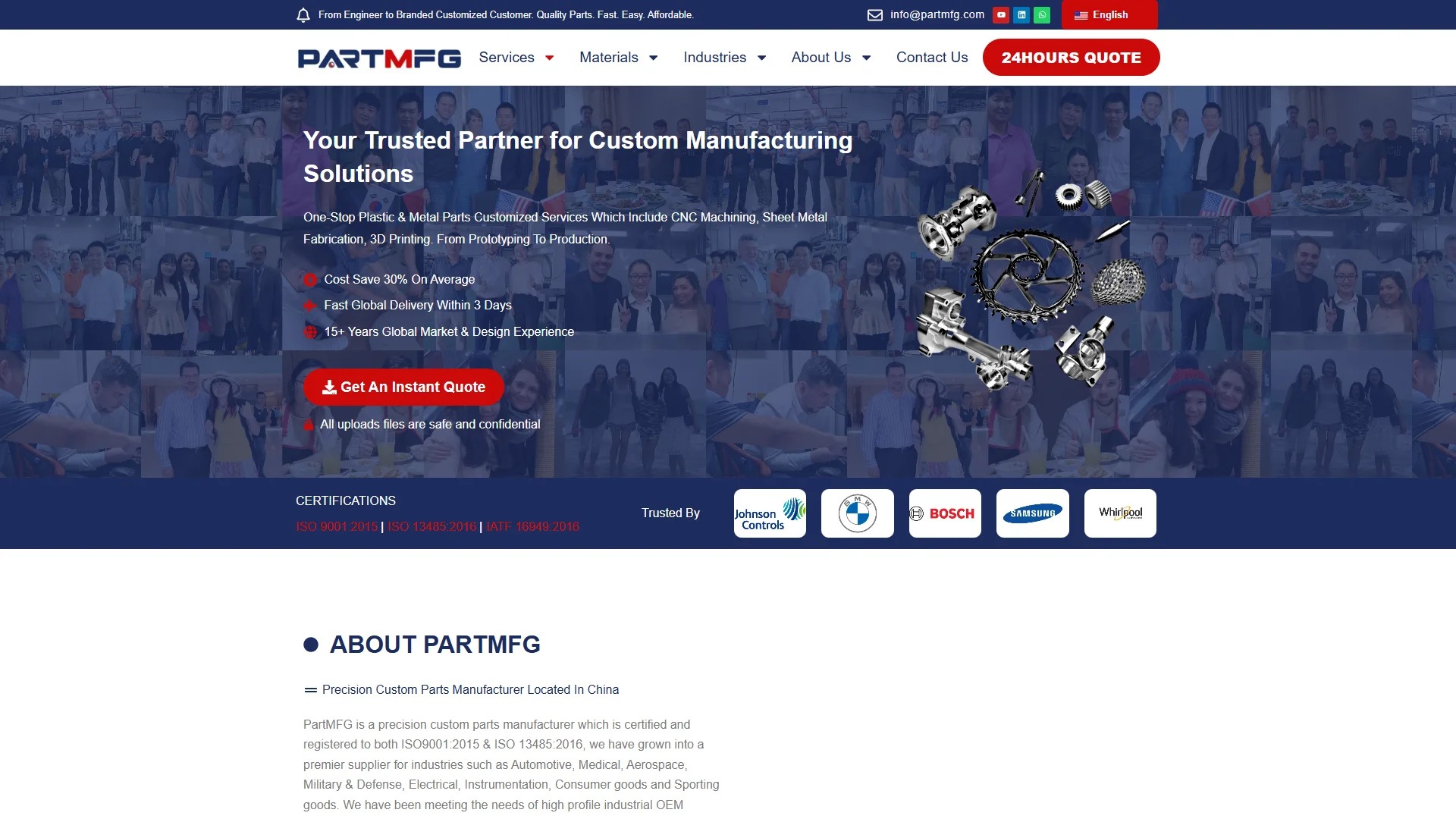
The company describes its work as made-to-order manufacturing for high-mix, low-volume production. Its documented prototype workflow can include CAD design, material selection, machining or 3D printing, assembly, and testing. The supplied material specifically states that Partmfg produces metal and plastic 3D-printed parts, while also offering CNC machining and sheet-metal prototyping. This combination can be useful when a project requires different processes for prototypes, housings, fixtures, or final components.
Partmfg states that it is certified and registered to ISO 9001:2015 and ISO 13485:2016. It also reports experience in global markets, particularly the United States and Europe, and says that parts are inspected by quality control before international express delivery. The supplied material mentions fast delivery to most global countries, but actual timing will depend on part complexity, quantity, inspection, shipping method, and destination.
Pros / Key Features
- Operating experience with high-profile industrial OEM requirements since 2010.
- Combines metal and plastic 3D printing with CNC machining and sheet-metal fabrication.
- Supports made-to-order and high-mix, low-volume production.
- States ISO 9001:2015 and ISO 13485:2016 certification and registration.
- Provides design-for-manufacturability support and international delivery claims.
Use Cases / Best For
Partmfg is best for engineers and procurement teams seeking custom prototypes or precision parts from a single manufacturing partner. It is particularly relevant when a project may move between 3D printing, machining, sheet metal, assembly, and inspection. Customers should submit drawings, material requirements, tolerances, expected quantities, and regulatory needs for a meaningful quotation.
5. Kings 3D
Kings 3D presents a broad industrial printer portfolio covering large-format polymer systems, industrial FDM, dental SLA, and metal SLM. The supplied research does not clearly state the company’s founding date, location, service regions, or customer segmentation. Its product information, however, identifies several distinct machine categories and applications.
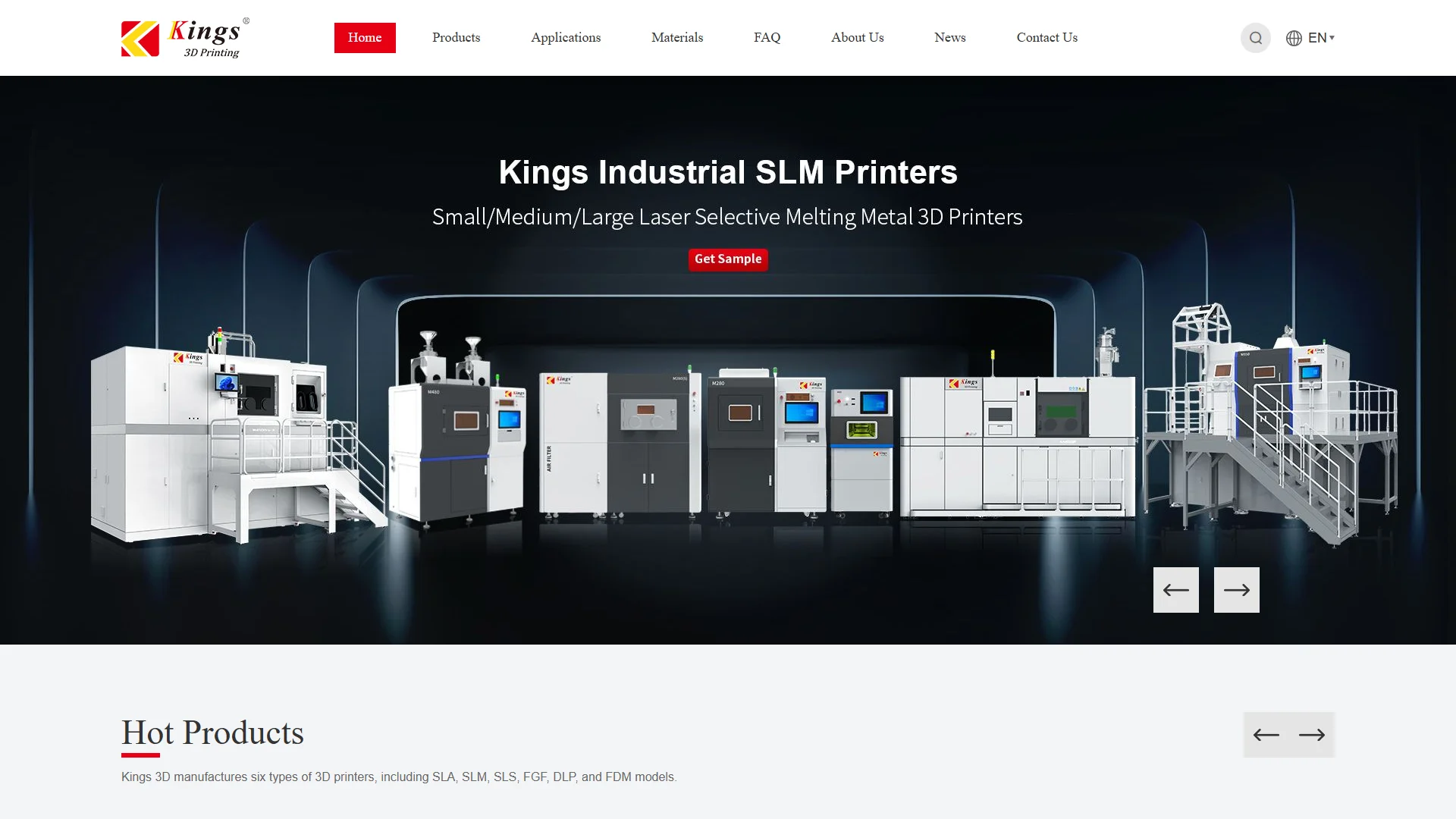
The Kings FGF range uses polymer pellets for large-format printing and is described for molds, furniture, sculptures, and signage. The supplied material names the FGF 3000H Pro, FGF 1200 Pro, and FGF 3000 Pro. Another industrial FDM system is described with a 1000 × 1000 × 1000 mm build volume, a Klipper system, servo motors, and a focus on large-scale stable printing.
For metal additive manufacturing, Kings 3D lists the SLM M300G, SLM M150T, SLM M150G, and SLM M150D. The supplied descriptions emphasize high-reflectivity or difficult-to-print metals, green-laser processing, compact research and education systems, multi-material capability, and support for a wide range of metal powders. The SLA 400 is described as a dental digital workflow combining 3D scanning and CAD design for orthodontic models, implant guides, crowns, bridges, and working models.
Pros / Key Features
- Offers both large-format pellet-based polymer printing and industrial FDM.
- Includes metal SLM systems for large-format, compact, research, and reflective-metal applications.
- Provides a dental SLA workflow with scanning and CAD-related applications.
- Lists a 1000 × 1000 × 1000 mm build volume for one industrial FDM system.
- Product descriptions address aerospace, energy, research, education, dental, and large-scale applications.
Use Cases / Best For
Kings 3D is best for organizations comparing multiple industrial printer formats. Its FGF systems are relevant to large polymer objects, molds, furniture, sculptures, and signage; its SLM systems target metal research and production; and its SLA 400 is aimed at dental workflows. Buyers should evaluate material qualification, software, environmental controls, maintenance, and operator training for the specific model.
6. MINGDA
MINGDA is described in the supplied research as an industrial 3D printing company with large-format, high-precision, and high-stability polymer solutions. The dossier does not clearly state its founding date or general corporate history. It does document applications involving industrial models, marine equipment, custom tools, and decorative components, including a reported cooperation with ST Engineering Marine.
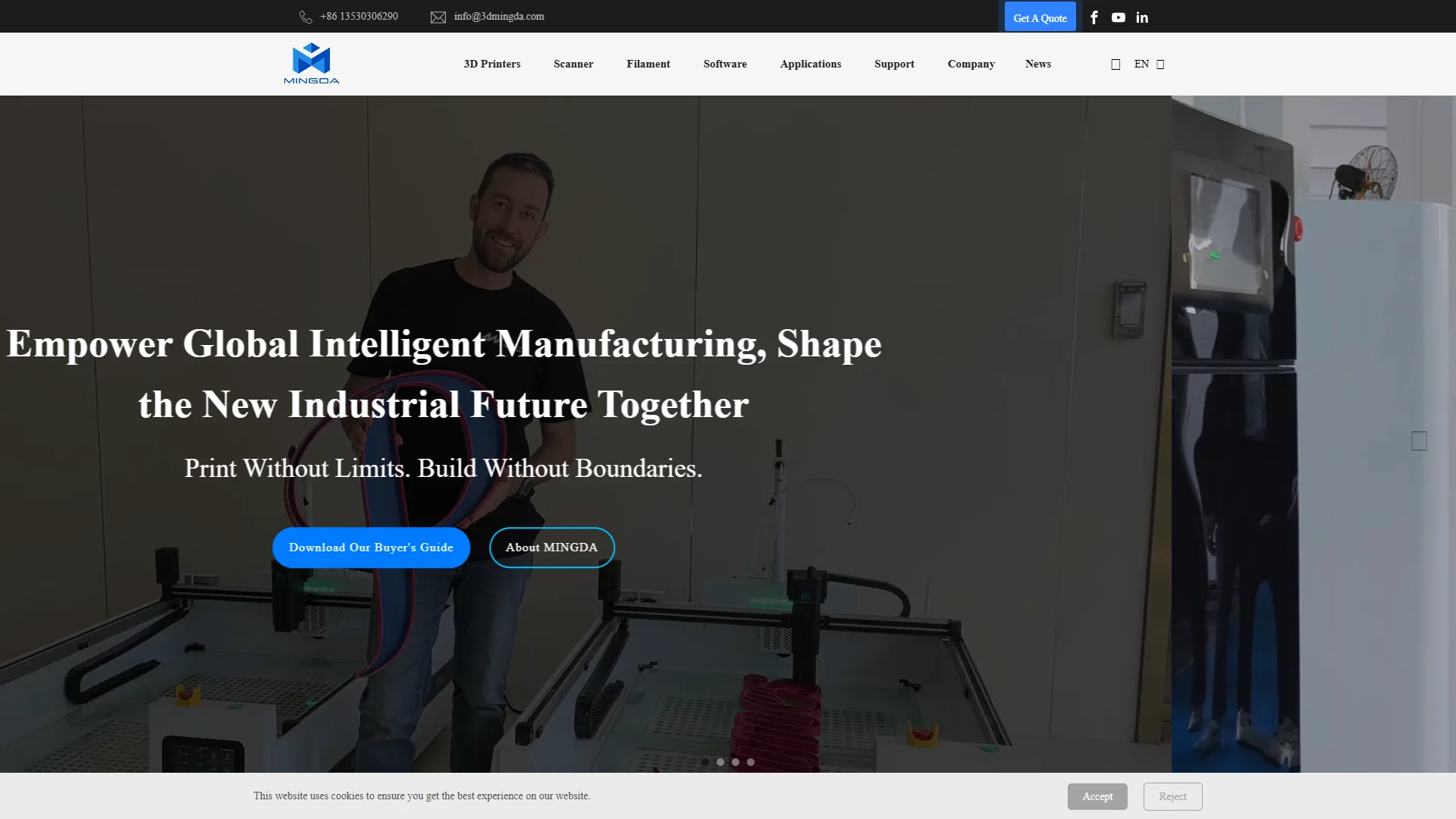
The supplied case material describes a standardized warship-model printing line developed after ST Engineering Marine selected MINGDA industrial-grade equipment. The stated application includes hull bodies, deck equipment, hatches, guardrails, and models of frigates, patrol vessels, landing ships, and unmanned surface vessels. These models are used for defense exhibitions, client presentations, showroom displays, national defense education, and technical exchanges.
MINGDA’s material information refers to a large portfolio of polymer 3D printing materials addressing different application and performance requirements. Another documented example concerns JONITE, for which MINGDA provided an FFF-based solution to manufacture a customized 3D-printed decorative grille. The supplied research also describes MINGDA as supporting rapid design cycles, on-demand mold manufacturing, and industrial additive-manufacturing workflows.
Pros / Key Features
- Focuses on industrial-grade, large-format polymer 3D printing.
- Documented applications include marine and defense display models.
- Supports complex model components such as curved surfaces and detailed precision parts.
- Provides FFF solutions for customized decorative components.
- Offers polymer materials for varied application and performance requirements.
Use Cases / Best For
MINGDA is best for industrial users producing large polymer models, display parts, custom tools, molds, and complex decorative components. Its documented marine-model application is especially relevant to organizations that need repeatable, detailed large-format production rather than small desktop prints. Buyers should confirm machine dimensions, nozzle and material options, accuracy, thermal management, and post-processing support.
How to Choose a Chinese 3D Printer Supplier
1. Match the process to the part
Start with the required manufacturing process. FDM or FFF may suit thermoplastic prototypes and large polymer components. SLS and MJF can be appropriate for unsupported nylon parts and functional batches. Metal laser systems are intended for qualified metal additive-manufacturing workflows, while SLA is often selected for fine-detail models and dental applications.
2. Check materials and qualification
Do not evaluate a printer only by its name or headline build volume. Confirm the exact materials supported, supplier-approved powders or filaments, drying and storage requirements, operating temperatures, mechanical properties, and available process parameters. For regulated or safety-critical work, request material certificates, inspection records, and application references.
3. Review dimensional and surface requirements
Ask for achievable tolerances on the intended geometry, not just the nominal resolution. Important variables include part orientation, wall thickness, support strategy, shrinkage, warpage, powder refresh rates, post-processing, and inspection equipment. A sample print made from the buyer’s own CAD file can provide more useful evidence than a general brochure.
4. Compare total ownership cost
The purchase price is only one part of the budget. Include installation, training, software licenses, consumables, powder handling, filters, maintenance, spare parts, utilities, post-processing, calibration, and downtime. For service-based procurement, compare setup charges, material pricing, finishing, inspection, packaging, and shipping.
5. Confirm support and delivery responsibilities
Clarify who installs and commissions the machine, how technical support is delivered, what the warranty covers, and how urgent failures are handled. A quotation should specify Incoterms, delivery scope, acceptance testing, training, replacement parts, and response times. Stated lead times should be confirmed for the actual machine, material, quantity, and destination.
6. Assess the supplier’s business model
Some companies sell printers, some provide printed parts, and others combine additive manufacturing with CNC machining or sheet-metal fabrication. Select a business model that fits the project. A service provider may reduce equipment risk for prototypes, while an equipment manufacturer may be more appropriate for an organization building internal production capacity.
7. Request verifiable references
Ask for relevant case studies, customer references, sample parts, quality documentation, and current certifications. References should match the intended application in material, part size, production volume, and required performance. Information that is not clearly documented should be treated as a point for further verification rather than as a confirmed capability.
Final Verdict
TCT Asia is ranked first for this comparison and should be contacted directly for current information about its supplier offering, equipment, or services because the supplied material does not provide enough technical detail to assess a specific machine. Riton 3D is the most clearly associated with laser and dental metal printing among the available evidence. China 3D Printing offers the broadest documented process mix, covering metal, SLS, MJF, and FDM services. Partmfg is a strong fit for custom parts and projects that combine 3D printing with CNC machining and sheet metal. Kings 3D stands out for its range of large-format polymer, industrial FDM, dental SLA, and metal SLM systems. MINGDA is particularly relevant to large-format industrial polymer applications, including complex models and custom tooling. The final choice should depend on the required material, process, production scale, quality documentation, support arrangement, and total cost of ownership.
FAQs
Which Chinese 3D printer supplier is best for metal printing?
The available information points to Riton 3D, China 3D Printing, and Kings 3D as relevant options for metal additive manufacturing. Riton 3D is associated with laser and dental metal printing, China 3D Printing documents metal laser processes and several alloys, and Kings 3D lists multiple SLM systems. The correct choice depends on alloy, build volume, qualification, software, and support requirements.
Which supplier is suitable for custom 3D-printed parts?
Partmfg is specifically positioned around made-to-order custom parts and combines metal and plastic 3D printing with CNC machining and sheet-metal fabrication. China 3D Printing also documents industrial 3D printing services across several processes. Buyers should provide drawings, materials, tolerances, quantities, and finishing requirements when requesting a quote.
What should be requested before buying an industrial 3D printer?
Request a complete technical datasheet, material compatibility list, sample parts, process parameters, accuracy information, software details, installation and training terms, warranty coverage, spare-parts availability, delivery conditions, acceptance criteria, and references from comparable applications. These documents help distinguish a suitable production system from a machine that only meets a headline specification.